From Clarence Road to the Cosmos
Gustav Holst, the composer whose suite "The Planets" remains among the most recognisable works in the classical canon, was born in Cheltenham on 21 September 1874. The Regency town provided the setting for his formative years, nurturing a musical talent that would eventually reach international audiences.
A Musical Household
Holst entered a family where music was already an established profession. His father, Adolph von Holst, served as organist and choirmaster at All Saints' Church in Cheltenham while maintaining a private teaching practice and giving piano recitals. This professional environment meant young Gustav encountered music as a practical craft from his earliest years, not merely as an artistic pursuit.
The Holst family brought diverse European musical traditions to Gloucestershire. Of Swedish, Latvian, and German ancestry, they counted professional musicians across three generations. Gustav's great-grandfather, Matthias Holst, had served as composer and harp-teacher to the Imperial Russian court in St Petersburg. His grandfather, Gustavus, emigrated to England in 1802 and established himself as a composer and harp teacher, adding "von" to the family name for professional distinction.
School Years and Early Composition
Between 1886 and 1891, Holst attended Cheltenham Grammar School. It was during this period, around 1886, that he began composing. His earliest works reflected the influences accessible to a young musician in late Victorian Cheltenham: Mendelssohn, Chopin, Grieg, and particularly Sullivan.
His musical education extended beyond the classroom. Holst received instruction on piano and violin, though he reportedly disliked the latter instrument. At age twelve, he took up the trombone, believing that the breathing required might improve his chronic asthma. This health condition, along with neuritis in his right arm, would shape his relationship with music throughout his life.
First Public Performances
Cheltenham provided the stage for Holst's early public performances. In November 1891, he appeared as a pianist alongside his father in the town, performing Brahms's "Hungarian Dances." These performances marked his gradual emergence from student to working musician.
Upon leaving Cheltenham Grammar School in 1891, Holst continued his musical development through four months of counterpoint study in Oxford. He then returned to Gloucestershire as organist and choirmaster at Wyck Rissington, a village roughly fifteen miles east of Cheltenham, and conducted the Bourton-on-the-Water Choral Society.
The Holst Birthplace Museum
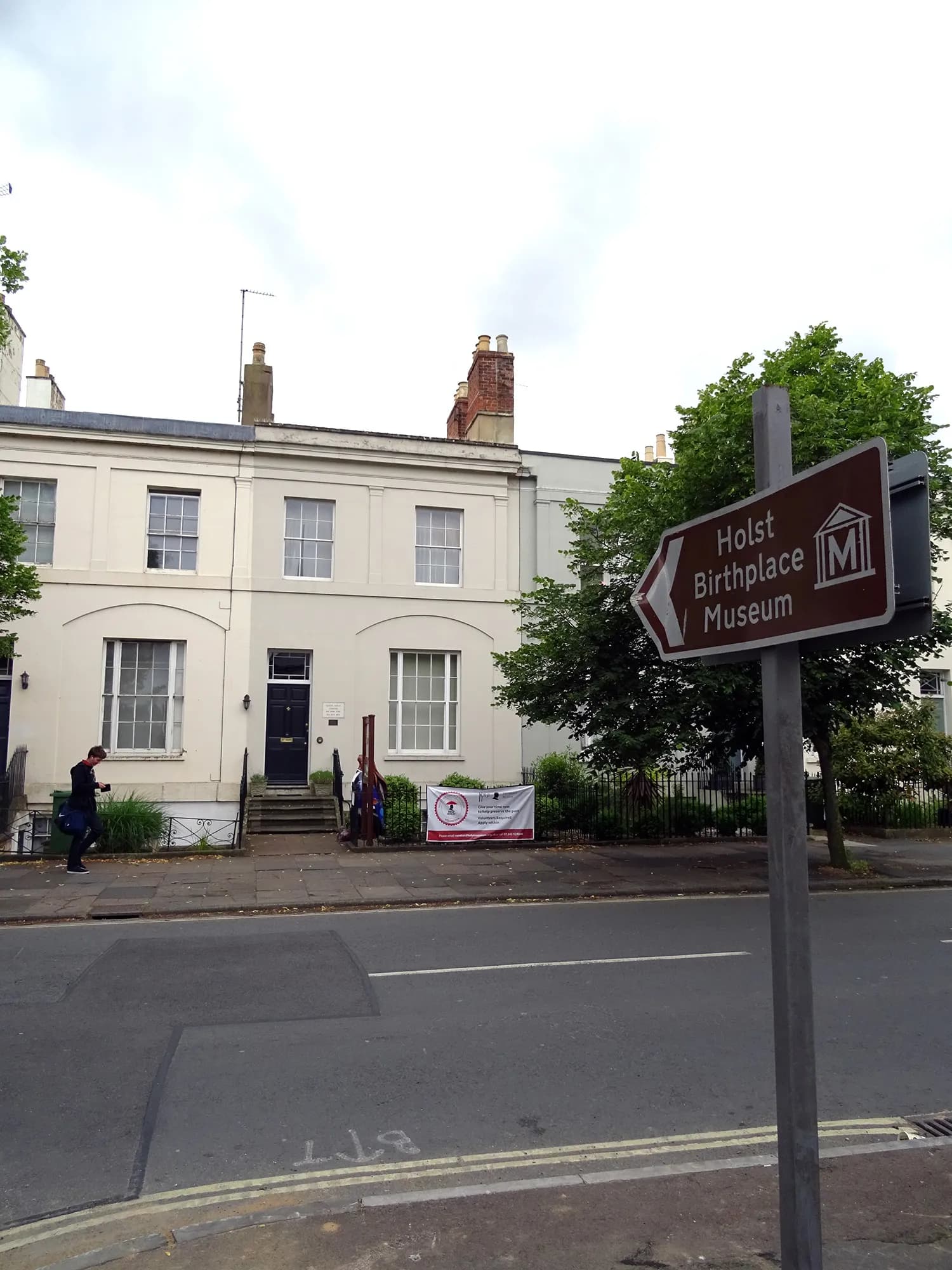
Today, 4 Clarence Road operates as the Holst Birthplace Museum, preserving the terraced house where the composer spent his first seventeen years. The museum maintains period rooms and exhibits documenting his life and work, allowing visitors to see the domestic setting that shaped one of Britain's most distinctive compositional voices.
While Holst would later move to London and travel extensively, his Cheltenham years established the foundation of his musical identity. The combination of his father's professional example, the structured education at Cheltenham Grammar School, and the practical experience of local performance created the conditions from which "The Planets" and his other major works would eventually emerge.