Lewis Brian Hopkin Jones, founding guitarist of The Rolling Stones, was born in Cheltenham's Park Nursing Home on 28 February 1942. The son of an aeronautical engineer and piano teacher, Jones spent his formative years in this Regency spa town before becoming rock music's most infamous rebel.
The Birth of a Musical Pioneer
Brian Jones entered the world on a Saturday in late February 1942 at the Park Nursing Home in Cheltenham. His parents, Lewis Blount Jones and Louisa Beatrice Jones (née Simmonds), were both of Welsh descent and provided their son with a solidly middle-class upbringing. His father worked as an aeronautical engineer whilst also teaching piano; his mother played piano and organ and led the choir at their local church. The family would expand with the birth of daughter Pamela in October 1943, though she tragically died of leukaemia in October 1945. A second daughter, Barbara, arrived in August 1946.
Jones's early childhood was marked by a significant health incident. At age four, he suffered an attack of croup that left him with asthma, a condition that would persist throughout his life.
Education and Early Rebellion
Jones's formal education began at Dean Close School on Shelburne Road in September 1949, when he was seven years old. He remained there until July 1953, when he passed the eleven-plus examination and secured a place at Cheltenham Grammar School for Boys, now known as Pate's Grammar School, on Princess Elizabeth Way.
Academically, Jones demonstrated considerable ability. He obtained seven O-level passes in 1957, continued to sixth form, secured two additional O-levels, and passed A-levels in physics and chemistry, though he failed biology. Despite this academic promise, Jones developed a reputation for conflict with authority. He was suspended from school on two occasions, his hostility towards authority figures and dislike of school uniforms marking him as non-conformist from an early age. Childhood friend Dick Hattrell later recalled: "He was a rebel without a cause, but when examinations came he was brilliant."
Musical Awakening in the Cotswolds
Jones's musical foundation was laid within his family home and the broader Cheltenham community. His father taught piano; his mother led the church choir. Young Brian listened to classical music, though he later developed a preference for blues, particularly the work of Elmore James and Robert Johnson.
In 1957, Jones first heard Cannonball Adderley's music and developed an interest in jazz. He persuaded his parents to purchase a saxophone for him. At Cheltenham Grammar School, he became first clarinet in the school orchestra. For his seventeenth birthday in 1959, his parents gave him his first acoustic guitar.
Whilst still living in Cheltenham, Jones began performing at local blues and jazz clubs, combining this with busking and various odd jobs. His rebellious nature occasionally caused trouble; he reportedly stole small amounts of money from his workplace to pay for cigarettes, resulting in his dismissal.
The Departure: Art College Rejection and London
In 1961, Jones applied for a scholarship to Cheltenham Art College. He was initially accepted, but the offer was withdrawn just two days later. An unidentified acquaintance had written to the college describing Jones as "an irresponsible drifter." This rejection proved pivotal; Jones left Cheltenham and moved to London.
In the capital, he immersed himself in the small but vibrant R&B and jazz scene, becoming friends with Alexis Korner, Paul Jones, and Jack Bruce. He briefly performed under the name "Elmo Lewis," playing slide guitar. Within a few years, he would place an advertisement in Jazz News that brought together Mick Jagger, Keith Richards, and the other musicians who would form The Rolling Stones.
The Final Return: Burial in Cheltenham
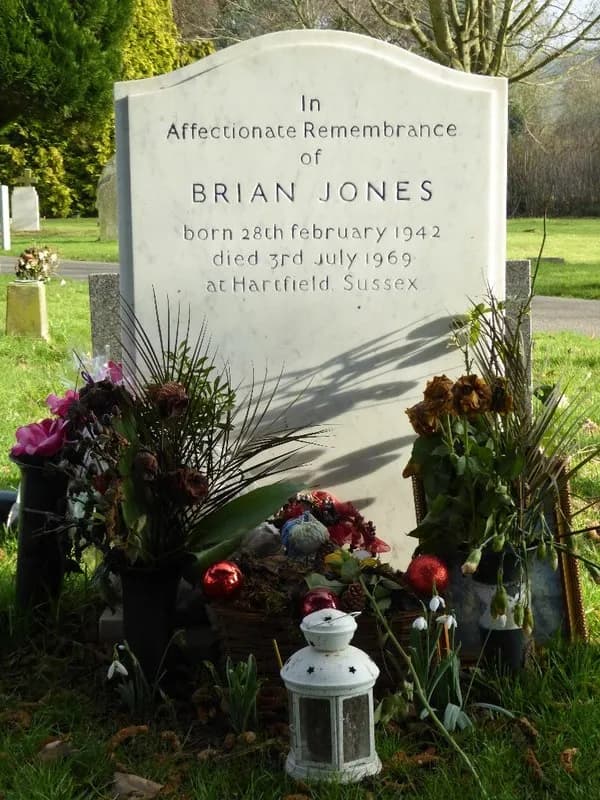
Brian Jones died on 3 July 1969 at Cotchford Farm in Hartfield, East Sussex. He was 27 years old. The verdict at his inquest was "death by misadventure," with drowning recorded as the cause. His body was returned to Cheltenham, where he was buried in Cheltenham Cemetery near Prestbury.
Legacy in the Town Today
Today, Jones's connection to Cheltenham is remembered in several ways. He is listed as a "Notable Old Decanian" on Dean Close School's alumni records and appears as a notable former pupil of Pate's Grammar School. His grave at Cheltenham Cemetery continues to attract visitors, particularly on significant anniversaries. In July 2019, fans decorated his grave to mark the 50th anniversary of his death.
Despite his global fame as a founding member of one of rock music's most enduring bands, Cheltenham's commemorations of its most famous musical son remain relatively modest. The town that gave Brian Jones his middle-class upbringing, his musical education, and his final resting place has yet to erect a major public monument or blue plaque in his honour.