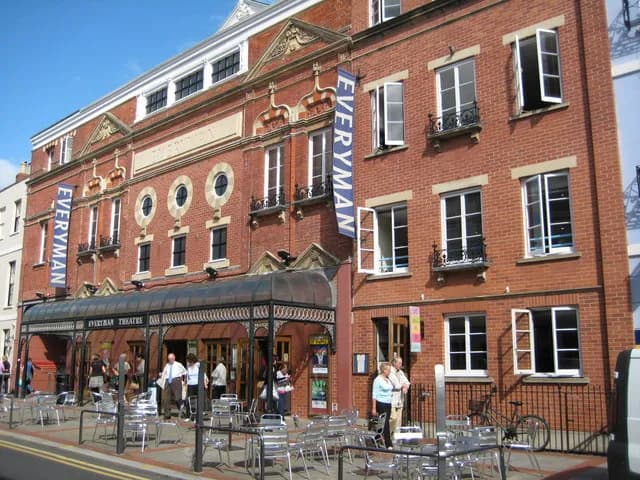
The Everyman Theatre on Regent Street houses Britain's oldest surviving working auditorium designed by Frank Matcham, the architect behind many of the country's finest Victorian and Edwardian theatres. Since opening in 1891, the building has seen multiple incarnations, survived wartime requisition, and escaped demolition through community action.
== A Matcham Masterpiece on Regent Street ==
The theatre opened on 1 October 1891 as the New Theatre and Opera House, built by Bradney and Co of Wolverhampton on the site of Cheltenham's former Assembly Rooms. Frank Matcham, then establishing himself as the pre-eminent theatre architect of his generation, designed the building in the Louis XV style. The original bench seating accommodated approximately 1,400 to 1,500 people, with a proscenium arch measuring 24 feet wide by 34 feet high and a stage depth of 45 feet.
The opening performance starred Lillie Langtry in Tom Taylor's "Lady Clancarty." The D'Oyly Carte Opera Company appeared regularly in the early years, alongside performers including Ellen Terry, Henry Irving, and later Charlie Chaplin. This programming established the venue as a significant stop on the British touring circuit.
== The 1929 Cinema Licence and Wartime Service ==
In 1929 the theatre obtained a licence to screen films, becoming a multi-purpose venue. The licence terms required live performances to continue alongside cinema screenings, a condition that preserved the theatre's theatrical function even as audiences increasingly favoured cinema.
During the Second World War the building served as a Garrison Theatre, presenting performances to civilians and United States soldiers stationed at Pittville. In 1941 the theatre hosted Lucan and McShane in "Old Mother Riley Pays Us a Visit"; according to contemporary reports in the Gloucester Citizen, more than 10,000 people attended, which the newspaper described as an all-time record for the Opera House.
== The 1959 Closure Threat and Rebirth as the Everyman ==
By 1959 the theatre faced closure and potential sale. The Cheltenham Theatre Association launched an urgent fundraising campaign that drew support from across the town. The effort succeeded: on 22 May 1960 the building reopened as the Everyman Theatre, named to reflect its programming for a broad audience.
The reopening featured the world premiere of N.C. Hunter's "A Piece of Silver," starring Joyce Heron and Esmond Knight. The 1960s repertory era saw future notable performers including William Gaunt, Steven Berkoff, Windsor Davies, and Penelope Keith pass through the company.
== The 1980s Rebuild and 2011 Restoration ==
Between 1983 and 1986 the theatre closed for substantial rebuilding and refurbishment, work that coincided with the Regent Arcade development. The reopened venue hosted "My Fair Lady" starring Jacqueline Dankworth.
A £3.2 million refurbishment completed in autumn 2011 revealed Matcham's original decorative scheme. Workers uncovered Scagliola marble on the proscenium arch, previously concealed beneath pink paint. The restoration also exposed spandrels above the arch containing original paintings of the angels of Comedy and Tragedy, along with cherub motifs and fine arts detailing that had been hidden for decades. The theatre reopened on 23 September 2011 with a performance by Ken Dodd.
== Heritage Listing and Current Status ==
The building is Grade II listed, reference 1387764, under Historic England's register. The main auditorium now seats 718, with a studio theatre accommodating 60. This two-auditorium configuration allows the venue to maintain the mixed programming that has defined it since 1960.
The theatre's Matcham-designed auditorium remains the architect's oldest surviving working example. Matcham's subsequent designs include London's Coliseum, the Hackney Empire, and the Victoria Palace; the Cheltenham auditorium precedes these by several years and provides the earliest surviving evidence of his theatrical work.
== Significance for Cheltenham ==
The Everyman occupies a unique position in Cheltenham's built heritage. The town's previous Theatre Royal on Bath Street burned down in 1839; its replacement, opened in 1850, was demolished in 1890 to make way for Matcham's building. This succession gives the Regent Street site continuous theatrical history stretching back to the nineteenth century, even as the physical structure has evolved.
The 1959 rescue campaign demonstrated the theatre's embedded place in local civic life. Today it continues as a receiving house for touring productions, pantomime, and local amateur companies, maintaining the function for which Matcham designed the auditorium 135 years ago.