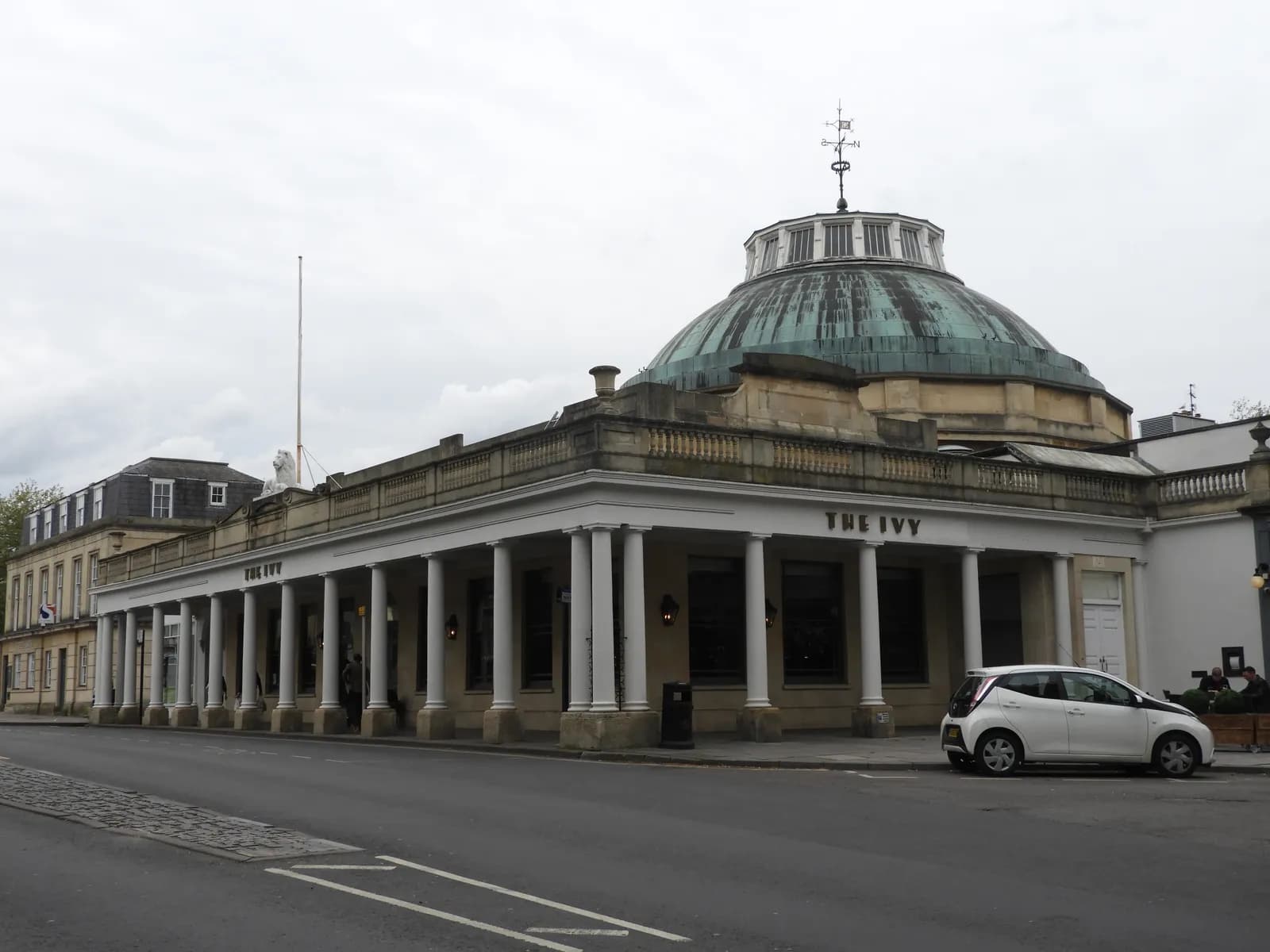
Standing at the southern end of Cheltenham's grand Promenade, the Montpellier Rotunda presents an arresting silhouette against the Gloucestershire sky. Its copper-clad dome rises with unmistakable Roman grandeur; a deliberate echo of the Pantheon that speaks to the ambitions of Regency England.
From Wooden Pavilion to Stone Masterpiece
The story of the Rotunda begins with Henry Thompson, who purchased land in the Montpellier area in 1801 after springs were discovered there. In 1809, Thompson opened a wooden pavilion with a colonnade to serve as a pump room for the mineral waters that drew visitors to the spa town. This modest structure proved insufficient for the growing fashionable trade, and in 1817 the building was reconstructed in stone under architect George Allen Underwood. Underwood's design included a distinctive crouching lion statue on the parapet, which remains a recognisable feature today.
The building's transformation into the architectural jewel Cheltenham recognises today occurred between 1825 and 1826. Architect John Buonarotti Papworth, described by architectural historian John Summerson as "one of the most versatile architects and decorative artists of the period," added the celebrated dome and rotunda. The structure Papworth created draws direct inspiration from Rome's Pantheon, with proportions that architectural critics have noted are almost identical to the ancient Roman original.
Dimensions and Design
The Rotunda measures 56 feet high and 54 feet across, creating a space of remarkable spatial drama. The exterior is constructed from limestone ashlar with a copper roof covering the hemispherical wooden dome. A Doric colonnade with slender shafts on raised plinths wraps around the structure, while the parapet retains Underwood's original lion couchant.
The interior is no less impressive. Light enters exclusively through a central circular skylight and lantern at the apex of the coffered wooden dome. Doric pilasters line the recesses below, with Corinthian pilasters rising above to create a rhythmic architectural sequence. Papworth designed all the interior fittings, including a magnificent chandelier and numerous mirrors; although these original elements no longer survive, the ceiling rose that once supported the chandelier remains in place.
A Stage for Society
The Rotunda quickly established itself as the social heart of Regency Cheltenham. Water from 80 surrounding wells was pumped from six o'clock each morning, serving visitors who came to take the waters for their health. Beyond its medicinal function, the building became a celebrated ballroom where the Duke of Wellington and other distinguished contemporaries graced the assembly room floor.
The Rotunda's musical credentials are equally notable. In 1848, the Swedish soprano Jenny Lind, known as "The Swedish Nightingale," gave a concert within its walls. In 1891, the space hosted first performances of works by a young local composer named Gustav Holst; his Scherzo and Intermezzo echoed through the domed chamber before the composer achieved international recognition.
Banking, Restoration, and a New Chapter
The building's ownership passed to Cheltenham Borough Council in 1893, along with the surrounding spa gardens. Banking operations began on the premises as early as 1882 with the Worcester City and County Bank agency, and by the early 1960s a branch of Lloyds Bank had opened within the historic structure. During this period, both the council and the bank undertook restoration work to preserve the Grade I listed building.
The Rotunda's most recent chapter began in 2017, when The Ivy Montpellier Brasserie replaced the bank after extensive restoration. The restaurant chain invested in returning the building to something approaching Papworth's original vision, including reinstating a chandelier from the original ceiling rose. The space now serves a similar social function to its Regency heyday, welcoming diners beneath the coffered dome that has dominated Montpellier Walk for nearly two centuries.
Cheltenham's Regency Legacy
Cheltenham has long claimed the distinction of being "the most complete Regency town in Britain." The Montpellier Rotunda stands as perhaps the most compelling evidence for this assertion. Architectural historian Nikolaus Pevsner, in his Buildings of England series, described the structure as "a masterpiece, providing Roman opulence and a great feeling of spaciousness within."
The building embodies the Neoclassical fascination with Roman antiquity that characterised the Regency period, when Britain's elite looked to the ancient world for models of civilisation and taste. The Pantheon-inspired dome represents not merely an architectural quotation but a statement of cultural aspiration; a declaration that Cheltenham belonged among the sophisticated spa towns of Europe.
Today, as visitors dine beneath the lantern that illuminates the coffered dome, they occupy a space that has witnessed nearly two centuries of changing British leisure habits. From health-seekers taking the waters to Victorian concert-goers, from banking customers to contemporary diners, the Rotunda has adapted to each era while retaining the architectural integrity that earned it Grade I listed status in March 1955. Its continued presence on Montpellier Walk ensures that Rome remains, in a sense, very much present in Regency England.